Nevada gaming regulator sues Coinbase over prediction Market

Coinbase, which runs one of the most popular crypto-currency exchanges in the world, now finds itself in legal trouble with the State of Nevada. It's not the company's traditional crypto exchange and wallet services that drew the ire of state authorities. Rather, the Nevada Gaming Control Board filed suit because of Coinbase's prediction market.
Wait, Coinbase Has a Prediction Market?

Coinbase's prediction market was launched on Wednesday, Jan. 28 and is available to customers in all 50 states. It's called “predictions” and is accessible on the Coinbase website under the “predict” entry in the left sidebar menu. This product is powered by Kalshi, the prediction market that recently partnered with The Lodge Card Club to offer contracts on the outcomes of live streamed poker games.
Coinbase customers can now use their US$ or USDC balances to buy and sell contracts related to sports contests, election results, entertainment markets, and many other events.
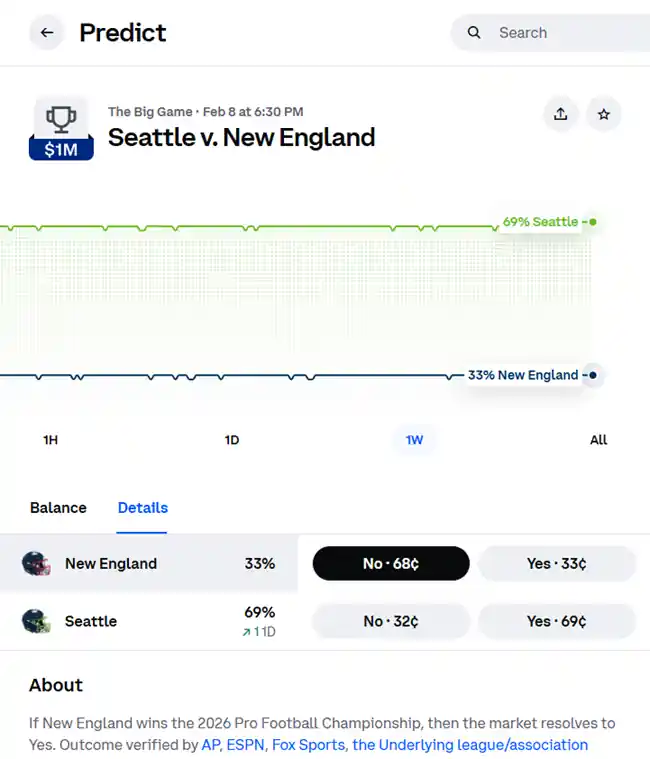 Contracts on The Big Game at Coinbase
If you think an event will happen, you can buy a “yes” contract, but if you think otherwise, then you can purchase a “no” contract. Each contract is priced between $0 and $1 depending on how likely the market of users thinks that outcome is. When these contracts settle, the ones corresponding to the outcome that actually occurred will pay out at $1 apiece while the opposite contracts will become worthless. In between the time you take a position in a market and the time that market resolves, you can liquidate your position at the market price, trading your contracts almost as though they were shares in a stock.
Nevada Thinks This Is Gambling

On Feb. 3, the Nevada Gaming Control Board posted a press release to its website explaining its actions. It said that the previous day (Feb. 2), the Board “filed a civil enforcement action in the District Court for Carson City֊” against Coinbase. The Board seeks “a declaration and injunction to stop Coinbase from offering unlicensed wagering in violation of Nevada law.”
Nevada contends that the sports contracts and certain other contracts offered by Coinbase are a form of wagering activity under state law, and thus, Coinbase requires licensure by Nevada to offer such products. Moreover, because the firm accepts customers between the ages of 18 and 21, it violates the provisions of NV law that only permit those above the age of 21 to gamble.
In concluding its statement, the Board noted:
Nevada’s public policy, as expressed by the Legislature, is that the gaming industry is vitally important to the economy of the state and the general welfare of the inhabitants and therefore must be licensed, controlled, and assisted to protect the public health, safety, morals, good order, and general welfare of the inhabitants of the state.
Coinbase's View

In the eyes of Coinbase, it doesn't require licensure from Nevada or any other state. It's already regulated by the Commodity Futures Trading Commission (CFTC) as a Futures Commission Merchant and Designated Contract Market.
Because Congress designated the CFTC as the regulator for event contracts nationwide, Coinbase is already properly licensed to conduct business in every one of the 50 states. The move by Nevada officials to exercise jurisdiction over this matter is therefore, according to Coinbase, a “power grab” and is invalid.
Ryan VanGrack, VP of Litigation at Coinbase, explained:
“Nevada’s lawsuit, filed without meaningful notice or opportunity for Coinbase to engage, is the type of state power grab that Congress explicitly prohibited when granting the CFTC exclusive jurisdiction over event contracts. It is also a manufactured emergency. This is a blatant attempt to end-run the Federal Courts’ consideration of these issues and underscores the need for consistent rules that protect consumers and ensure equal access to these markets — regardless of where you live in America.
Nevada in a War Against Prediction Markets

Coinbase is just the latest of the prediction market providers that have attracted the attention of the Nevada government. It has been taking steps for a while to hinder their operations.
In March 2025, the NGCB sent Kalshi a cease-and-desist letter, but the firm sued and won a preliminary injunction, which allowed it to continue operating in Nevada. However, in November, this injunction was dissolved.
Competitor Polymarket, meanwhile, was also targeted by Nevada officials who sued it in January 2026. On Jan. 29, the court issued a two-week temporary restraining order against the site, which covered the period during which the Super Bowl occurred, preventing Polymarket from profiting from this potentially lucrative event.
Other States Take Aim at Prediction Markets

Nevada isn't the only state that has a problem with prediction markets. In late November 2025, Tennessee's Sports Wagering Council issued cease-and-desist letters to Kalshi, Polymarket, and Crypto.com stating that these platforms were engaging in unlicensed sports betting. On Dec. 3, 2025, the Connecticut Department of Consumer Protection Gaming Division sent cease-and-desist orders to Kalshi, Robinhood, and Crypto.com claiming that their prediction markets were illegal. Other states, including Arizona, Illinois, Maryland, New Jersey, Montana, and Ohio had sent similar correspondence to prediction markets earlier.
Massachusetts has gone beyond just sending letters and has actually obtained a preliminary injunction against Kalshi. It's not clear what the long-term effects of this injunction might turn out to be, but it appears that Massachusetts is attempting to block its residents from being able to access Kalshi's sports contracts while allowing them to trade other types of contracts.
In Connecticut, Michigan, and Illinois, Coinbase didn't wait to be targeted by state authorities but instead fired the first shot by filing lawsuits against these states on Dec. 18. Coinbase stated that it believed that enforcement actions from these states were imminent and would harm its planned business actions within the states.
CFTC Flexing Its Muscles

In the past, the CFTC has at times opposed the expansion of prediction markets into sports and election contacts though it ultimately lost these battles in court. New CFTC chairman Michael Selig, who took office in December 2025, appears to be taking a different tack.
On Feb. 5, the CFTC sought permission from the U.S. Court of Appeals for the Ninth Circuit to file an amicus curiae brief in the lawsuit between Crypto.com and Nevada. An amicus curiae (literally “friend of the court”) is an individual or organization that's not part of a lawsuit but nevertheless seeks to inform or influence the court in making its decision.
Selig has withdrawn proposed rules that would have prohibited prediction markets from dealing in political and sports contracts. He also rescinded guidance that counseled prediction markets to prepare themselves for litigation and regulatory action from the states. It appears that the CFTC's amicus brief will focus on the federal regulator being the sole legitimate authority over event contracts, to the exclusion of state agencies, and on the legitimacy of sports and events contracts.
Early Skirmishes Inconclusive

As part of its lawsuit against Coinbase, Nevada sought a temporary restraining order and preliminary injunction to block its residents from being able to use Coinbase's prediction products. However, this move was rejected by state court.
Coinbase then sought to sue Nevada in federal court, blocking the original case from proceeding through the Nevada courts. However, on Feb. 4, the federal court sided with Nevada, meaning that the original suit against Coinbase will be able to proceed at the state level.
Offshore Betting Easier?

It's early days yet in terms of how prediction market sports event contracts will shake out legally. But you shouldn't let this hinder you if you're keen on sports betting. Traditional offshore sportsbooks are happy to accept your action.
Among the best of them is Lucky Rebel, which lists a broad range of U.S. and international sporting contests. When you create a new account, you can look forward to a 200% up to $2,500 bonus to bet on sports. You can also use this bonus to play casino games.
You can find out more about this bookmaker with this Lucky Rebel Sports review. Or for a list of other reputable, U.S.-facing sportsbooks, head over to this page about betting on sports online.
Feb. 10, 2026 – by Max Golden, Editor-in-Chief