New York Sues Valve Over Video Game Loot Box Gambling

We've seen many states go after various forms of what they consider illegal online gambling lately, and now New York is expanding its reach in this area. The Empire State has filed suit against Valve, the creator of Counter-Strike, Team Fortress, Dota, and other popular video games. Court documents show that the use of loot boxes in these games constitutes illegal gambling in the eyes of New York officials.
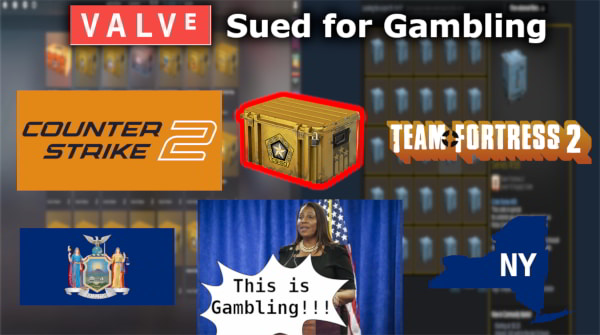
What Is a Loot Box?

The focus of New York's lawsuit is on loot boxes available in Valve's Counter-Strike, Team Fortress, and Dota 2 games. Loot boxes are randomly spawned items in a game that can be opened to reveal items. Most loot boxes require a key to open, and this key costs actual real money to purchase.
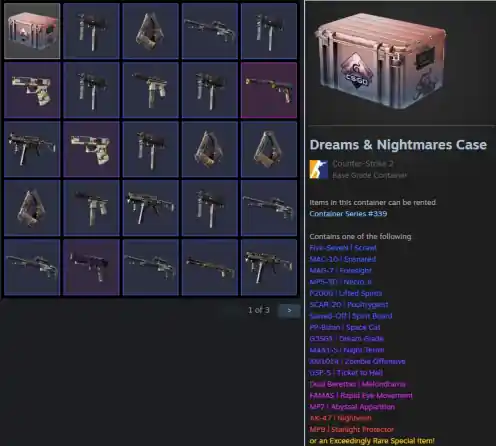 Loot Box Called “Dreams & Nightmares Case” for Counter-Strike 2
All Possible Items Within Are Listed
After buying the key and opening the box, the user receives an item of varying rarity and thus desirability. In the case of Valve's games, these items provide no gameplay advantages and are merely for cosmetic effect. They might alter the appearance of the player character or the weapons in an individual's inventory. These items are often referred to as “skins.”
Customers can sell the loot box items they receive through the Community Market on Steam, where they receive Steam Wallet funds. There are also third-party marketplaces where skins can be exchanged for cash.
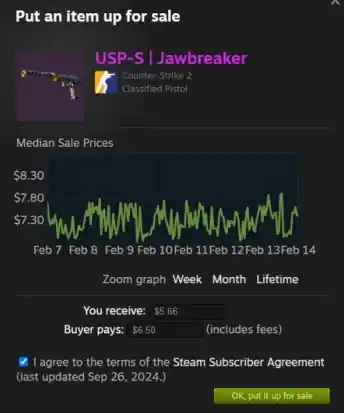 Selling a Loot Box Skin on the Steam Community Market
Why Does New York Think Loot Boxes Are Gambling?

According to New York Penal Law § 225.00(2):
"Gambling." A person engages in gambling when he stakes or risks something of value upon the outcome of a contest of chance or a future contingent event not under his control or influence, upon an agreement or understanding that he will receive something of value in the event of a certain outcome.
Because the keys to open loot boxes can be purchased with normal fiat currency, they count as “something of value” for the purposes of this definition. The loot box mechanic sees the item given to the user chosen randomly, and no amount of skill or strategy by the customer can affect this selection, so it's definitely determined by chance and is not under anyone's control or influence.
The final part of the definition of gambling under state law requires that certain outcomes correspond with awarding something of value. Here's where Valve's algorithms for determining what is awarded by a loot box come into play.
The original philosophy with regard to loot boxes was once very different. As noted in New York's complaint:
When it first introduced loot boxes, Valve believed it was important to ensure that users would not feel they had chosen the wrong option—i.e., paid more for the key than the value of the item they won. As one senior Valve developer explained in 2014, Valve wanted to avoid a situation where a user who spent $2.49 to open a crate and received an item available for purchase on Steam for $0.50 would feel like they “just lost $2 of actual value.”
However, such noble concerns on the part of Valve management soon fell by the wayside. The loot boxes were changed such that they deliver a paltry amount of value the overwhelming majority of the time. Today, users routinely receive an item worth one-tenth or one-twentieth the amount they paid to open the loot box and only rarely receive a prize worth hundreds or thousands of times what they paid. This only strengthens the argument that this activity is a type of gambling.
More About Third-Party Markets

Because sales of loot box items on Steam result in a credit to the user's Steam Wallet, which can only be spent within the Steam platform, an argument can be made that loot boxes cannot be redeemed for anything of real value and thus do not constitute gambling. However, an investigator was able to sell a skin on the Steam Community Market, take the Steam Wallet funds thus received and purchase a portable gaming system called a Steam Deck, and sell the Steam Deck at a retail electronics store for $180.
Various third-party marketplaces dispense with all pretense and allow the direct exchange of loot box virtual merchandise for real money. Another advantage of such outside markets, from the users' point of view, is that they're not subject to the transaction limits in place on the Steam Community Market, and therefore, the rarest items can sell for much more than is allowed on Steam.
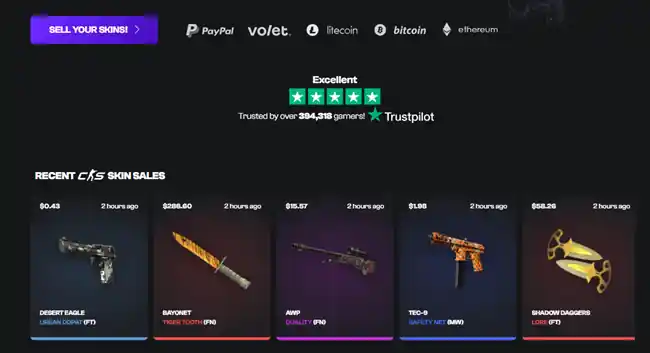 Third-Party Counterstrike Skins Marketplace Skinflow.gg
Valve does not control such markets, and the company claims that Steam's Subscriber Agreement bans the sale of virtual items on other platforms. Valve says that it routinely tries to stop trading sites that permit individuals to sell loot box items for real cash.
Yet, Valve provides every user with a URL that facilitates such trades, and it even explicitly instructs customers that they can use this URL on “third-party trading sites.” New York's complaint cited numerous instances where Valve assisted these third-party markets in conducting their business functions even to the extent of unbanning their accounts that had inadvertently been targeted for violations of the rules.
Valve Promoting Underage Gambling?

If Valve's loot box mechanics are indeed a type of gambling, then it's almost certain that the corporation is facilitating underage gambling. The New York minimum gambling age is 18 or 21 depending on the type of gambling involved, but Valve allows customers as young as 13 to sign up for accounts on Steam.
Even the 13-year-old age limit is not strictly enforced in practice. New users need merely check a box stating “I am 13 years of age or older and agree to the terms of the Steam Subscriber Agreement and the Valve Privacy Policy.” Only rarely are further checks or identity verification performed by Valve.
How Big Is the Loot Box Economy?

Given that the keys to open loot boxes generally cost a small sum between $2 and $3 apiece, some might be surprised to find out the astronomical sums involved in this gaming mechanic.
Citing figures from Bloomberg, New York's court filling contends that the market for Counter-Strike skins exceeded $4.3 billion as of March 2025. Among these transactions, one single skin sold for $1 million in June 2024. The high value of some of these items have made them attractive targets for hackers who were responsible for $6 million in thefts of Counter-Strike skins in the single month of August 2022 alone.
What Does New York Want?

In its 52-page complaint, signed by Attorney General Letitia James, New York laid out its case against Valve. The document was filed with the New York County Clerk on Wednesday, Feb. 25, 2026.
In a statement, Attorney General James said:
Illegal gambling can be harmful and lead to serious addiction problems, especially for our young people. Valve has made billions of dollars by letting children and adults alike illegally gamble for the chance to win valuable virtual prizes. These features are addictive, harmful, and illegal, and my office is suing to stop Valve’s illegal conduct and protect New Yorkers.
 New York Attorney General Letitia James
New York alleges that Valve is violating the anti-gambling provisions of the New York State Constitution and has committed the offenses of promoting gambling in the second degree and first degree. The defendant's actions, New York argues, amount to “repeated and persistent illegal conduct.”
New York wants the court to enjoin Valve from violating the state's constitution and anti-gaming laws. It also wants a complete accounting of money lost by New Yorkers as a consequence of “Defendant's illegal acts” with such funds being paid back to consumers as restitution. Furthermore, the state seeks to have Valve pay for “damages caused, directly or indirectly” by the illegal activities of the company, including “applicable pre-judgment interest.”
The lawsuit seeks to direct the “Defendant to disgorge all monies” stemming from these illegal practices and pay a fine of three times its gain from the illegal actions. New York seeks also any other “equitable relief” that might be required to redress the supposed violations of state law along with $2,000 and “such other and further relief as the Court deems just and proper.”
Loot Boxes Targeted Before

Loot boxes have drawn the ire of gambling regulators before. However, most of these previous actions have been in smaller jurisdictions or did not seek to ban them altogether.
In 2016, China's Ministry of Culture issued regulations that permit loot boxes, but they have to follow strict rules. The odds of acquiring each skin must be clearly stated, and it must be possible to gain each item through normal gameplay in addition to obtaining it from a loot box. In 2019, China added daily limits to the amount of money a player can spend on in-game purchases, like loot boxes.
In 2018, the Belgian Gambling Commission decided that loot boxes that required the user to pay to open them violated gambling law. However, compliance with this decision has been spotty, and many companies have elected to not obey the law in this matter.
In August 2020, a class action lawsuit was filed against EA Games in California, seeking $5 million in damages and arguing that loot boxes were a type of gambling. However, the court declined to rule on the merits of the case and instead ordered the parties to proceed to arbitration.
Loot Boxes Lack Skill

Loot boxes might be fun, but there's no exercise of skill involved in them. If you would rather play a game of skill, then online poker might be right up your alley. There are a number of online poker rooms that happily accept U.S. players.
We think that Ignition Poker is among the best of them. You can sign up for Ignition Poker and receive a 150% up to $1,500 bonus to play poker on your first crypto-currency deposit. Click the button below to get started:
To learn more about Ignition first, head over to this detailed Ignition Casino Poker review. For additional sites available to Americans, read this USA offshore poker guide.
March 3, 2026 – by Max Golden, Editor-in-Chief