Federal Government Sues 3 States Over Prediction Markets

The battle between state regulators and prediction markets has been heating up lately with various lawsuits filed over the issue of whether or not trading on these markets constitutes a type of gambling. Now the Commodities Futures Trading Commission (CFTC) is throwing its hat into the ring by suing several states, arguing that it, and it alone, has the authority to regulate these markets.
About the Lawsuits

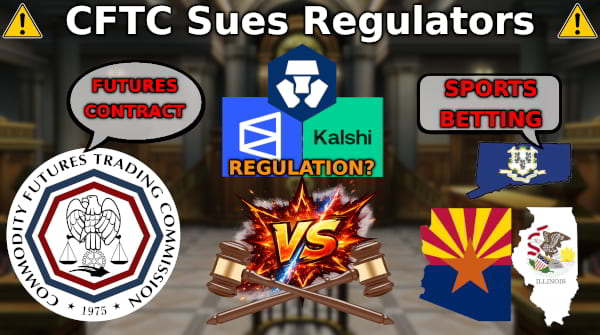
In a statement on its website, the CFTC explained its reasoning. It's suing Arizona, Connecticut, and Illinois for their actions against designated contract markets that are registered with the CFTC. The CFTC argues that the Commodity Exchange Act gives it “clear and longstanding exclusive jurisdiction” over these markets.
Illinois authorities sent cease-and-desist letters to Robinhood (4/1/25), Kalshi (4/1/25), Crypto.com (4/1/25), and Polymarket (1/27/26) regarding “Suspected Illegal Sports Wagering” at these prediction market platforms. On March 17, 2026, Arizona filed 20-count misdemeanor charges against Kalshi for alleged infractions, including accepting bets from Arizonans and election wagering. Connecticut, for its part, sent cease-and-desist letters to Robinhood, Kalshi, and Crypto.com in December 2025 accusing them of conducting illegal gambling.
However, the CFTC contends that the contracts being traded on these prediction markets are not a form of gambling or sports betting. Rather, these markets involve event contracts that are the domain of the CFTC to oversee. Thus, the states are exceeding their authority in seeking to regulate such markets.
What Are Prediction Markets?

Before we proceed further, perhaps it would be a good idea to go over, in simple terms, what exactly prediction markets are and how they operate. These markets, which are hosted by the likes of Kalshi, Polymarket, Crypto.com, and Robinhood, allow users to trade contracts tied to certain outcomes occurring or not happening.
For example, for a market entitled “Will the European Central Bank hike rates in 2026?” there might be two contracts available: one labeled “yes” and the other called “no.” You can purchase whichever one you think will turn out to be correct at current market prices, which will range between $0 and $1.
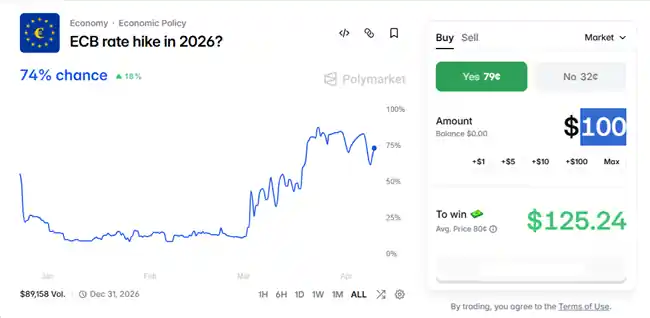 Will the European Central Bank Raise Rates in 2026?
At the time the market is resolved, which will probably be at the end of 2026, those who hold “yes” contracts will be rewarded with a payout of $1 for each contract they own if the ECB did raise its rates in 2026. Should the contrary prove correct, then those holding “no” will instead receive $1 for every contract they possess. In either case, the “losing” contracts will expire worthless.
At any point after purchasing a contract and before it resolves, you may sell it. The price is determined similarly to shares on the stock market with a spread between bid and ask prices and the possibility to make market or limit trades.
Besides markets with just a single “yes” and “no” contract available, there are others that have multiple sets of contracts being traded. An example might be a market on who will be named Secretary of Justice in a new Presidential administration. There could be three or more possibilities each with their own contracts in favor or against a particular individual with separate prices for all of them (although they will, of course, be inversely correlated with each other).
Why Are States Interested in Prediction Markets?

It was just a few years ago that prediction markets were largely ignored by almost every state. They were able to conduct their business without worrying about 50 different legal codes and only had to be concerned about what the CFTC had to say about their operations.
However, in January 2025, Kalshi started offering contracts based on the outcomes on sporting events, followed by Polymarket in December 2025. Meanwhile, Crypto.com has been offering such products since December 2024.
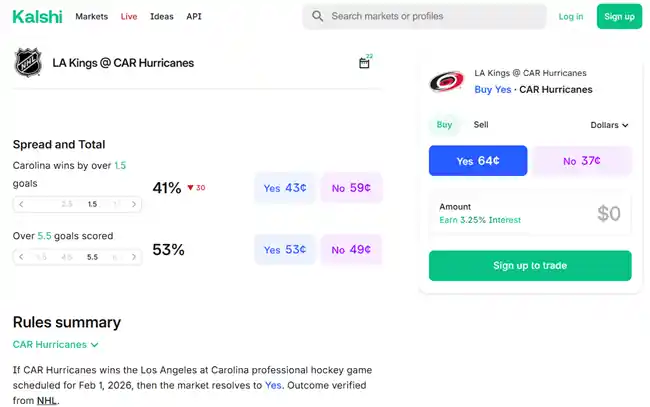 Example of Sports Markets Available at Kalshi
These new offerings followed a wave of state-level sports betting legalization and expansion starting in 2018 after the Supreme Court decision in NCAA v Murphy. This ruling ended the federal ban on sports betting expansion, allowing states to legalize and regulate this type of gambling.

Some three dozen states now permit sports betting. Most of them allow online sportsbooks to secure licenses to operate within their borders, but a few of them restrict such wagering to brick-and-mortar locations. Regardless of the particulars in any single state, there's one thing they all have in common: They each levy taxes on and thus generate revenue from betting on sports.
Therefore, states with authorized sports gambling view prediction markets as entities offering similar services but without being licensed to do so and without paying any state taxes. It's understandable that they're unhappy with this state of affairs.
Many States Involved in Disputes

The CFTC has sued Illinois, Arizona, and Connecticut specifically for their actions against prediction markets, but other states have conducted similar crackdowns. No fewer than 11 states have sent cease-and-desist orders to various prediction markets, including Tennessee, Montana, New Jersey, Maryland, New York, and Michigan. Some states have even sued prediction markets, like Washington State, which filed a lawsuit against Kalshi in March 2026 and Nevada, which sued Coinbase in February 2026. Coinbase is a crypto-currency exchange that recently added predictions to its menu of services.
Prediction markets haven't taken this lying down either. They've proactively initiated legal proceedings against various states as well. After Washington State sued Kalshi, Robinhood filed suit against the state to try to protect its own prediction markets. Kalshi, fearing impending legislation in the Utah legislature, sued the state arguing that the proposed law treads inappropriately on regulatory ground properly the domain of the federal government.
The verdicts of a few relevant court cases have already come down, like a recent ruling that denied New Jersey the right to regulate prediction markets. In March 2025, New Jersey issued a cease-and-desist letter to Kalshi claiming that the company was violating the New Jersey Sports Wagering Act and the New Jersey Constitution by offering unlicensed sports wagering to residents of the Garden State. In response, Kalshi sued the state, and in April 2025, a district court ruled in favor of the prediction market, telling New Jersey officials that they had no authority to regulate these markets. New Jersey appealed, but on April 6, 2026, a federal appeals court upheld the original decision against New Jersey.
However, a court case in Nevada appears to be going in the opposite direction. On March 20, 2026, the Carson City District Court issued a restraining order against Kalshi, and this order was extended by 14 days on April 3. We're still waiting on a final decision in the case, but it seems to be going against Kalshi at the moment.
Litigants Weigh In

Regarding its reasons for attempting to assert its sole authority over prediction markets at this time, CFTC Chairman Michael S. Selig explained:
The CFTC will continue to safeguard its exclusive regulatory authority over these markets and defend market participants against overzealous state regulators. This is not the first time states have tried to impose inconsistent and contrary obligations on market participants, but Congress specifically rejected such a fragmented patchwork of state regulations because it resulted in poorer consumer protection and increased risk of fraud and manipulation.
 CFTC Chairman Michael S. Selig
However, the states being sued have an understandably different perspective. A spokesperson for Illinois Governor J.B. Pritzker stated:
The Trump Administration is carrying water for companies driving well-documented and lucrative insider trading schemes. These firms are making record profits while exposing Illinoisans to gaming products with no basic consumer protections or oversight. This is a blatant attempt to sidestep the State's jurisdiction and put profits ahead of consumers. Illinois isn't backing down -- we will continue to fight to protect Illinois consumers.
Prediction Markets Expanding

According to a report from Dune and Keyrock, monthly prediction market volume reached $13 billion in November 2025 up from less than $100 million less than two years prior. These markets are expanding their offerings, which means this number is likely to grow further in the upcoming future.
For example, in December 2025, Coinbase added predictions to its menu of products in partnership with Kalshi. In November 2025, Polymarket made a deal with Hustler Casino to carry contracts on the results of streamed live poker games, and Kalshi inked a similar agreement with The Lodge in February 2026.
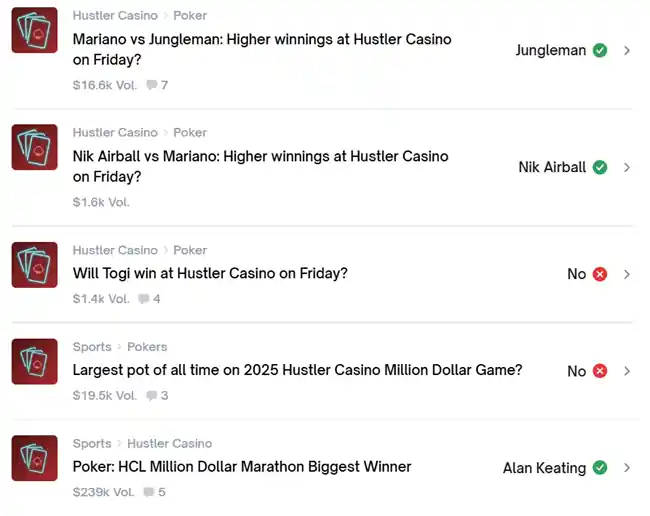 Examples of Poker-Related Contracts Offered at Polymarket
As this rapidly burgeoning industry seeks to proceed forward with new products to entice new customers, it will undoubtedly appreciate legal clarity as to how and by whom it can be regulated. The results of the three lawsuits from the CFTC will help establish much-needed clarity on these points.
Congress Getting in on the Action

The United States Congress is also seeking to regulate prediction markets. On March 26, 2026, three Democrat lawmakers, Senator Jeff Merkley of Oregon, Senator Elizabeth Warren of Massachusetts, and Representative Jamie Raskin of Maryland, introduced the STOP Corrupt Bets Act. This bill would prevent prediction markets from trading contracts involving elections, sports, certain government decisions, and war.
Should this legislation pass and become law, it will likely trump whatever the courts decide. It would also probably supersede any attempts by the states to regulate such markets.
Betting the Traditional Way

If you like to make a bet now and then on games that catch your eye, then you might want to avoid the controversy-laden prediction markets. You can instead open an account with a traditional online bookmaker, like Lucky Rebel.
Lucky Rebel is available in 49 states. It gives new customers a 200% up to $2,500 bonus upon making their first deposit. You can join Lucky Rebel today by clicking the button below:
To gain a better understanding of how this online sportsbook works, check out this Lucky Rebel Sports review. For other highly rated US-friendly options, head over to this list of top internet sportsbooks for Americans.
Last Updated March 18, 2026 – by Max Golden, Editor-in-Chief