Canadian Supreme Court Denies Appeal in Major Poker Tax Case

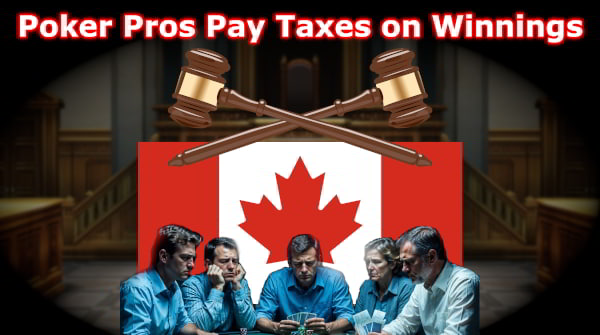
On June 4, 2026, the Supreme Court of Canada decided to dismiss the appeal of several poker players who were looking to have their poker earnings exempt from taxation. This means that the original Tax Court ruling that they have to pay taxes on poker winnings was upheld.
What's the Significance of This Case?

In several highly publicized previous cases, Canadian courts held that poker winnings were non-taxable. This follows the principle in Canadian law that income derived from gambling is generally not subject to tax.
The standard appeared to be set in the case of Radonjic v. Canada (Revenue Agency), 2013 FC 916 in which a serious online poker player, Peter Radonjic, filed to have the taxes he had paid on his poker revenue refunded. The court agreed with Mr. Radonjic that his poker winnings were non-taxable.
The case of Duhamel v. The Queen, 2022 TCC 66 involved 2010 World Series of Poker Main Event winner Jonathan Duhamel. The Tax Court of Canada found that Duhamel's earnings from poker were not taxable income.
 2010 WSOP Main Event Champ Jonathan Duhamel
Based upon these and other verdicts, many individuals in Canada gladly pursued careers as poker pros secure in the knowledge that the income they thereby derived was not subject to income tax. Some people even moved to Canada from abroad based partially on the favorable taxation regime for poker. However, with the rules now seemingly turned upside-down, these people may be in for a surprise as the Canada Revenue Agency comes looking to collect what it believes is its due.
More About the Case

The case that the Supreme Court declined to review was actually three separate cases:
- Fournier Giguère v The Queen, 2022 TCC 66
- Bérubé v. The King, 2023 TCC 12
- D'Auteuil v. The King, 2023 TCC 3
All three appellants (Martin Fournier-Giguère, Antoine Bérubé, and Philippe D'Auteuil) are poker players who earned considerable income from the game between 2008 to 2012 and were friends with each other. They each had received notices of reassessment indicating that they owed back taxes on this income. Each of the appellants disagreed with the reassessment, and they individually took their cases before the Tax Court of Canada where they lost.
They decided to appeal their Tax Court losses. Because their cases were very similar and covered basically the same period of time, their appeals were combined. The case was heard before the Federal Court of Appeal. The decision, rendered on June 10, 2025 by Justice René LeBlanc, saw the appeals denied and the original Tax Court rulings against the appellants upheld.
Now that their appeal to the Supreme Court has been declined, it seems these three have no further legal recourse. They'll have to pay up or face the consequences.
Legal Principals at Issue

You might be wondering what the differences are between the older cases, decided in favor of the poker players, and the newer ones, which were settled in favor of the taxation authorities. Well, it turns out that all gambling income is not treated the same under Canadian law, and so we need to take a quick detour through the relevant parts of the law before we answer this question.
Gambling is generally considered a personal hobby, and it's not held to be a taxable “source of income.” However, if the gambling is undertaken as a business, then the situation changes and any winnings derived from it become subject to tax although legitimate business deductions are allowed.
Key Factors at Play
When determining whether or not someone gambles for amusement or for business, the courts try to figure out if their play was a commercial endeavor and whether or not they intended to make a profit from it. This is a gray area, and there's no tried-and-true test for definitively answering the question one way or the other.
What the courts do in practice is look at a variety of factors and then weigh the probabilities of the arguments in both directions to make a decision. Some of the relevant elements are:
- Whether the gambler was able to support themselves through their play or had other sources of income
- Whether the gambler had special training or education to help him or her succeed
- The degree of organization employed by the gambler when placing his bets/plays
- The amount of time spent and/or scale of the gambling
- The level of accounting and record-keeping done by the gambler
- Whether the gambling results came about purely through chance or whether there was an element of skill
- The amount of profit achieved and its sustainability over time
Catch 22?
Although this didn't come up in any of the cases we're discussing today, the way gambling tax law works in Canada sometimes leads to a “damned if you do, damned if you don't” result for the taxpayer. Someone attempting to write off gambling losses may have their deductions disallowed on the grounds that their lack of success and inability to support themselves from winnings means that their gambling was not a business but merely a personal hobby. Yet, someone else doing exactly the same type of gambling but with better results might be liable to pay taxes on what is clearly a business because they showed consistent profits over time and were able to fund their daily life from their winnings.
The courts have repeatedly recognized the unfairness of this type of reasoning. The distinction between gambling as entertainment and gambling as a business cannot be merely the difference between losing and winning. Perhaps the tax law needs to be amended so that such palpably unjust outcomes are no longer possible or at least much less likely.
Fournier-Giguère et al. and Duhamel Differences

In the case of the three poker playing friends whose cases were combined, the courts found that they made almost all their income from poker. Each of them booked winnings consistently year after year. They employed sophisticated tools and strategies to manage their business, like tracking software. Finally, they used their skills and knowledge of the game of poker to defeat their opponents on a regular basis.
All of these factors, taken into consideration together, led the court to surmise that the three individuals were engaged in gambling as a business rather than for personal amusement. As the court noted, they “devoted almost all their time, apart from when they were sleeping, eating, or partying, to poker.”
It may seem bizarre that Jonathan Duhamel, who has likely won more than Fournier Giguère, Bérubé, and D'Auteuil put together – and certainly has wider name recognition as a poker pro – should have been branded an amateur player. Yet, the court in Duhamel's case recognized that he had other sources of income, which supported his lifestyle, from which he earned the money that he used to fund his poker endeavors. This tends to support the conclusion that Duhamel's poker playing was a personal pastime rather than a business.
However, we have no way of knowing for certain whether Duhamel's outside income was the key element in the judgment being rendered in his favor. Since the law regarding poker taxes is so dependent on an individual's particular situation, other of the factors considered by the court could have contributed to the judge's reasoning.
Conclusion

There are myriad differences between each taxpayer's individual situation, which makes it difficult to understand in any particular case why someone playing poker might be considered either gambling as a business or as a pastime. Nevertheless, with the recent upholding of the Tax Court ruling in Fournier Giguère, et al., it seems the trend is against poker players who wish to escape Canadian income tax.
Because the legalities surrounding poker taxation in Canada are so murky and uncertain, many players have likely been avoiding taxes that they will now owe. A smaller number perhaps have been paying taxes even though they were not required to.
This legal uncertainty makes it difficult for aspiring poker players to understand what their tax obligations might be either in the present or going forward. Canada, once viewed as a haven for poker players, especially those who play online, could see its popularity among pokerists decline.
Play Online for Fun and Profit

Whether you intend to play poker as a hobby or a serious business endeavor, you can get started online. This is much easier than getting dressed and driving to the nearest casino. You can play for much lower stakes online too than you can at almost any terrestrial cardroom.
One of the best internet poker sites for Canadians is Ozoon, which formerly was known as Bodog. It's ready to welcome you with a 100% up to $1,000 poker bonus as well as additional bonuses to play casino games and bet on sports. Press the button below to sign up:
You can read more about Ozoon by consulting this Bodog review, which was written before the site rebranded yet still contained valuable info. For additional poker site available in Canada, check out this Canada offshore poker guide. If you live in the United States, then it would be better for you to browse over to this rundown of the top online poker sites for American players.
June 9, 2026 – by Max Golden, Editor-in-Chief